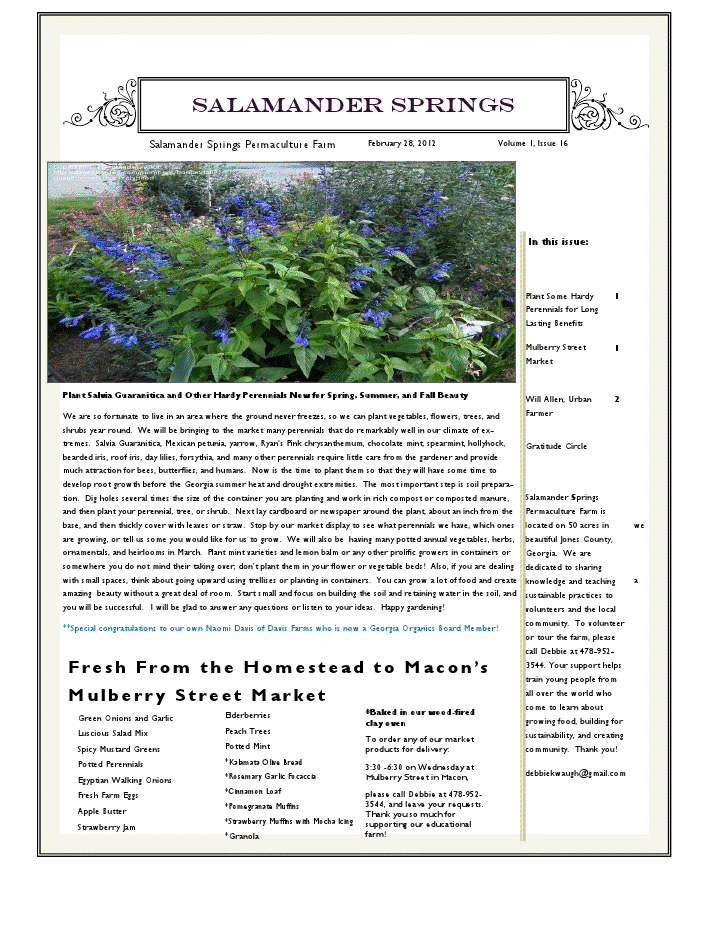
Late again ... apologies.
Here's Walter Reeve's most recent column from the AJC. There's lots more here.
Gardening - 4:54 p.m. Tuesday, February 28, 2012
Q: I'm a first-time asparagus planter and just received my plants in the mail. The directions say to open up a trench in which to plant them. Do I bury the connected part of the roots or should I bury each individual root, leaving the middle exposed? -- Darren Kubiak, Lawrenceville
A: Asparagus is a perennial plant, so proper planting is important. I call the center part of asparagus roots the "crown" and the thick fingers spreading from it the "roots." It's best to bury the crown relatively shallow, just an inch or so, but the roots can be 2 to 4 inches deep. I typically dig an area 6 inches deep and wide enough to contain the root system when spread out. I put a clod of clay under the crown to support it a couple of inches higher than the roots around it.
Q: I have a well established lawn of centipede grass. Which comes first, aeration or dethatching? -- Earl Spell, Sharpsburg
A: Generally speaking, you don't need to remove thatch if you aerate a lawn every year or so. The aerator brings up plugs of dirt that help to speedily decompose a layer of thatch. You also can minimize thatch formation by mowing regularly, only removing a third of the height at each mowing.
Q: We have moved to northeast Georgia from south Florida. Knowing I need to protect my staghorn fern from winter freezes, can I have any possibility of success with it during the growing season? -- Roy Riggs, Dahlonega
A: If you have a good place to keep it indoors in winter, you can bring it in and out each year, as you’d do with any tropical plant. If your fern grows too large to carry, you can pull off newly emerged fern sprouts, mount them on a piece of wood and give to your new Lumpkin County neighbors.
Q: Do you know a source for mason bees in Georgia? I have a friend on the West Coast who swears by them for increased crops. -- A. G. Borud, email
A: Mason bees are a terrific substitute for honeybees when you have a fruit or vegetable garden. Unlike honeybees, they are solitary and make nests in hollow stems or tubes. No one sells them locally, to my knowledge. Your best bet is to buy them online. They will arrive in paper tubes containing several cocoons. The best housing is translucent paper tubes inserted in a short piece of four inch diameter plastic pipe. Mount the pipe to your garage or shed wall, under the overhang. Mason bees are active in spring and make cocoons for their larvae to hibernate in during summer and winter. You can remove the tubes in summer to see how many cocoons you have and to inspect for predators and parasites. Good sources for bees and their housing include Crown Bees (www.crownbees.com) and Knox Cellars (www.knoxcellars.com).
Q: I am looking for a pollinator for tea viburnum. Is there another viburnum that would suit its needs? -- Phil Greenawalt, email
A: Tea viburnum has perfect flowers (male and female parts in the same bloom) but it won't accept its own pollen. In order to get the bounteous berries for which it is famous, you need to have nearby a tea viburnum that came from different parents. Call several local nurseries and ask where they get their tea viburnum shrubs. If they come from different wholesale growers, it's likely that you'll get plants with different genetic parentage. These will pollinate each other nicely.
Listen to Walter Reeves Saturday mornings on AM 750 and 95.5 FM News-Talk WSB. Visit his website, www.walterreeves.com, or join his Facebook Fan Page at xrl.us/wrfacebook for more garden tips.
Since mom threw a quote from Cicero in that last newsletter and I just happen to be a Latin teacher, allow me to expound.
Here's what Cicero said (Letters to Friends, Book 9 Letter 4): "si hortum in bibliotheca habes, deerit nihil.”
While often loosely translated into English as "If you have a garden and library, you have everything you need", what that quote really says is, "If you have a garden IN your library, nothing will fail".
I will be the first to admit that I haven't the foggiest notion what Tully (as he was known among friends) was talking about. A cursory google search provided a reliable source who thinks Cicero is referring to an ornamental garden, such as the ones philosophers sat in and discussed age old questions about chickens and eggs and what-not, and probably not a vegetable garden, which wouldn't be in any ordinary sort of library.
Comment away if you have any thoughts.
Sorry this one's late ...
Saturday Farmers Market in Milledgeville presents local, farm-fresh, seasonal food!
Just because it’s winter doesn’t mean there isn’t an abundant supply of local, farm-fresh, seasonal produce, meat, eggs, bread and dairy products available to residents of the Milledgeville community as well as those living in surrounding counties.
This Saturday, Feb. 11, from 9 a.m. to noon, the parking lot of the First Presbyterian Church on Wayne and Greene streets in Milledgeville will be filled with an assortment of farm-fresh, nutritious and delicious foods, courtesy of a new farmers market opportunity.
The market, which opened the winter season on Jan. 14 as a huge success, will host 12 local vendors from within 100 miles whose farms and businesses are dedicated to providing nutritious and sustainable products.
Scheduled for Second Saturdays in the winter and weekly after the Grand Opening on April 14, this market is a partnership between First Presbyterian Church, The Milledgeville Community Garden Association, and Live Healthy Baldwin.
Come sample, browse and meet the folks who are passionate about bringing their products directly to you! A list of this week’s goodies and the vendors include:
Three Centuries Farm: free-range eggs, pastured pork including bone-in and boneless pork chops, Boston Butt, picnic shoulder, ham hocks, sausage (links, patties and ground)
Salamander Springs Farm: mustard greens, salad mix, green onions, kalamata olive bread, apple butter, strawberry jam, potted perennials, herbs and edibles
The Little Farm: apple jelly, apple butter, lavender jelly, lavender cookies, fresh-milled bread, turnips, beets, salad mix, bunching onions, spinach, broccoli, kale, radishes
Fort Creek Farm: grass-fed ground beef, roasts, steaks, soup bones and dog bones
Babe & Sage Farm: artisan bread, free-range eggs
Vesterfield Farm: salad greens, carrots, collards, cabbage, green pepper jelly, kale, homemade cakes
Elm Street Gardens: salad greens, collards, kale, chard, carrots, winter vegetables, and farm-fresh eggs
Southern Swiss Dairy: Milk (whole, 2%, skim, chocolate), buttermilk, heavy cream, 1/2 n' 1/2, ice cream (vanilla, chocolate and strawberry), salted and unsalted butter, Brown Swiss beef
Evergreen East: pork and lamb - all cuts available
Rocking Chair Ranch: T-bone and rib-eye steaks, filet, ground beef
Flat Creek Lodge: 13 varieties of artisanal cheese
Tink's Beef: variety of grass-fed beef and pastured pork cuts
Join your friends and neighbors this Saturday at the market, located at First Presbyterian Church, 210 South Wayne St., Milledgeville, Georgia.
For more information, call (478) 414-6433.